If you have spent more than five minutes shopping online today, you have already experienced it: the “Copy-Paste-Fail” cycle. You find a site promising “80% off,” you click the button, a dozen pop-ups explode across your screen, and when you finally paste the code into the checkout box, the red text appears: “Coupon code not recognized.”
Most users assume this is a glitch. Some assume the retailer is being stingy. But the truth is far more calculated.
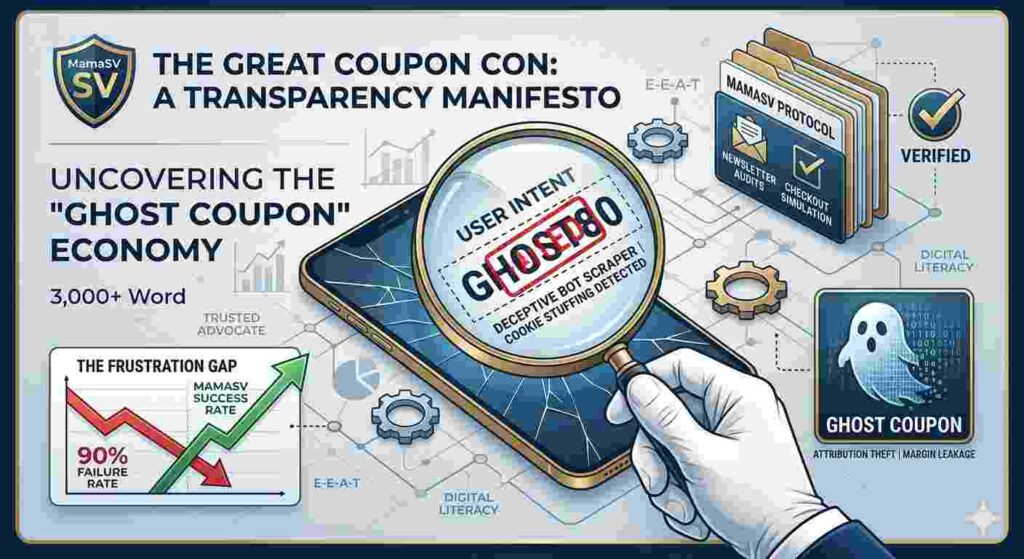
At MamaSV, we’ve decided to break the “Omertà” of the discount industry. The reason most coupons don’t work isn’t because they expired yesterday; it’s because they were never meant to work in the first place. They are Ghost Coupons—digital phantoms created by automated scrapers to hijack your browser’s cookies and steal “attribution” from honest creators.
This is our Transparency Manifesto. We are pulling back the curtain on a multi-billion dollar deception to show you how the industry actually works, why your favorite brands are frustrated, and how we are rebuilding the bridge of trust between shoppers and savings.
1. Anatomy of a “Ghost Coupon”: The Industry’s Dirty Secret
To understand why your screen is filled with non-working codes, you have to understand the Scraper Bot Economy.
In 2026, the majority of “coupon sites” are not run by humans. They are automated shells, scripts designed to “crawl” the internet, find a legitimate code from a brand’s private newsletter or an influencer’s social media, and instantly duplicate it across thousands of low-quality domains.
The Psychology of the “Fake High”
Why would a site list a code they know is broken? Because in the world of affiliate marketing, the “Last Click” is king.
When you click “Reveal Code” on a shady site, two things happen simultaneously:
-
The Deception: A window pops up showing you a code that likely expired months ago (or was completely fabricated).
-
The Theft: In the background, the site “drops a cookie” in your browser. This digital tracker tells the retailer, “Hey, if this person buys anything in the next 30 days, I am the one who referred them.”
Even when the code fails at checkout, the site still gets paid a commission on your full-price purchase. They have successfully “stuffed” your browser with their tracking data by promising a discount they never had the power to give. This is Attribution Theft, and it’s the primary reason the internet is littered with “Zombie Codes.”
The “Expired on Purpose” Strategy
Have you ever noticed codes from 2022 still sitting at the top of a search result in 2026? This isn’t laziness; it’s a calculated SEO tactic. These sites know that users search for “Store Name + Coupon.” By keeping thousands of dead codes active, they capture “long-tail” search traffic. They prioritize Search Engine Rankings over User Success Rates.
2. Behind the Screen: The Dirty Tactics of the Discount Industry
To protect your time and your data, you need to recognize the three primary tactics that shady coupon sites use to trap unsuspecting shoppers. Once you see them, you can never unsee them.
Cookie Stuffing
This is the most common form of fraud in the discount space. A site will force your browser to visit multiple affiliate links in the background the moment you land on their page. This “stuffs” your browser with dozens of cookies for different retailers. Whether you use a coupon or not, that site is now positioned to collect a “bounty” on almost anything you buy for the next month.
The “Click-to-Reveal” Trap
You’ve seen the boxes that say “Click to Reveal Code.” In many cases, the code isn’t actually hidden for privacy—it’s hidden to force a user interaction. That click is the trigger for the affiliate cookie. Honest sites (like the one you are on now) will often show you the code upfront or provide a clear, one-click copy function that doesn’t refresh your entire browser or open intrusive tabs.
Zombie Codes and Logic Loops
A “Zombie Code” is a coupon that has been “dead” for years but is repeatedly “resurrected” by automated scripts. These scripts see that people are still searching for the code, so they simply update the “Verified On” date to today’s date.
3. The Digital Literacy Gap: What Users Are Actually Asking
When we looked at the data for what shoppers are asking in 2026, the confusion is palpable.
-
“Why does my browser extension find 20 codes, but none of them work?”
-
“Why did my price go UP after applying a coupon?”
-
“Is this site going to sell my email address?”
The answer to all of these lies in the Quality of the Data Source.
Most browser extensions use the same “Scraper Bot” data we just described. They are effectively “Automation on top of Automation.” They don’t have a relationship with the brand; they are just throwing digital spaghetti at a wall and seeing what sticks. This doesn’t just waste your time—it creates a “Coupon Exhaustion” where users eventually stop looking for deals altogether because the success rate is so low.
MamaSV was built to solve this specific “Exhaustion.” We realized that the only way to win in 2026 was to go in the opposite direction: Fewer codes, but 100% accuracy.
4. The Retailer’s Perspective: Why Brands Are “Hiding” Their Coupons
To understand the full scope of the coupon crisis, we have to look at the brands themselves. In 2026, many high-end retailers and Direct-to-Consumer (DTC) brands are in a state of “Promo Fatigue.” When a brand releases a coupon code intended for their loyal email subscribers or a specific podcast audience, they expect it to stay within that community.
Instead, within minutes, “Scraper Bots” have lifted that code and plastered it across the internet on sites that have zero relationship with the brand. This creates three major problems that ultimately hurt you, the consumer:
The “Margin Leakage” Crisis
Retailers use discounts to attract new customers or reward loyalty. When a “Ghost Coupon” site hijacks a sale from a customer who was already at the checkout page ready to pay full price, the brand loses money without gaining any new value. This is known as Margin Leakage. To combat this, many brands are forced to lower their discount percentages across the board. The fake coupon sites are literally making your real discounts smaller.
The Sabotage of Influencer Partnerships
Many of the best codes you find—like a 30% off code for a boutique skincare line—come from influencers or creators who have a direct partnership with the brand. When a scraper site steals that code, they often “overwrite” the influencer’s credit. This means the person who actually introduced you to the product doesn’t get paid, and the scraper site gets a commission for doing nothing.
The “Hidden Field” Trend
Have you noticed that some checkout pages now hide the “Promo Code” box behind a tiny link or at the very bottom of the page? This is a defensive move. Brands are trying to discourage the “tab-switching” behavior where a user leaves the checkout to go find a fake code.
At MamaSV, we work with brands, not against them. By ensuring our codes are authorized and active, we help maintain the health of the retail ecosystem, which ensures that deep discounts stay available for everyone.
5. The MamaSV “Human-Verified” Protocol: Rebuilding Trust
Because the internet is flooded with automation, the only way to provide value in 2026 is through radical manual effort. We don’t believe in “Volume”; we believe in Velocity and Veracity.
While a typical coupon aggregator might host 50,000 “Zombie Codes” for 10,000 stores, we focus on a curated selection of brands where we can guarantee a 95%+ success rate. Here is exactly how we verify a code before it ever touches your screen.
Step 1: Origin Tracking (The “Source of Truth”)
We don’t “scrape” other sites. Our team tracks codes back to their primary source:
-
Direct Partnerships: Official affiliate networks where the brand issues unique codes to MamaSV.
-
Newsletter Audits: We subscribe to over 2,000 brand newsletters to catch “Flash Sales” the second they are announced.
-
Social Intelligence: We monitor official brand handles on X (formerly Twitter), Instagram, and Discord to capture real-time social-only promos.
Step 2: The “Checkout Simulation” Audit
This is where the real work happens. Every week, our verification team performs Live Checkout Simulations. We don’t just “check” if a code exists; we test it against specific criteria:
-
Does it have a minimum spend? (e.g., “Only works on orders over $100”).
-
Is it category-specific? (e.g., “Only works on clearance items”).
-
Does it stack? (e.g., “Can be used alongside a site-wide sale”).
If a code doesn’t meet its promised value, we don’t list it. Period.
Step 3: The “Decay” Filter & User Feedback Loop
Even a verified code can “decay” if a brand hits their budget limit early. We use a real-time feedback loop. If three users in a row report a code as “Failed,” our system automatically flags it for a manual human re-test within the hour. We would rather have an empty page than a page full of lies.
Step 4: Privacy-First Verification
In 2026, many coupon “tools” require you to install a browser extension that tracks every move you make online. MamaSV is different. We provide our verification as a public service on our site. We don’t track your browsing history, and we don’t require you to “Log In” to see our best deals. We believe your data is your own, and a discount shouldn’t come at the cost of your digital privacy.
6. The Difference Between “Static” and “Dynamic” Coupons
To be a truly “Expert” shopper, you must understand the difference between the codes you find.
-
Static Coupons: These are long-term codes (like
WELCOME10) that stay active for months. These are the easiest to find but often offer the lowest value. -
Dynamic/Unique Coupons: These are one-time-use codes issued via email. Scraper sites often list these, but because they are “single-use,” they are dead the moment the first person uses them.
At MamaSV, we clearly label our codes so you know exactly what you are getting. If a code is a “Site-Wide Verified” discount, we mark it. If it’s a “Limited Time Flash Sale,” we give you the countdown timer.
7. The Future of Ethical Savings: Toward a “Zero-Knowledge” Model
As we look toward the remainder of 2026 and beyond, the relationship between shoppers, retailers, and discount platforms is undergoing a seismic shift. The “Scraper Bot” era is dying because it is built on a foundation of poor data and broken trust.
At MamaSV, we believe the future lies in Zero-Knowledge Savings.
What is Zero-Knowledge Shopping?
Currently, most coupon platforms want to “own” your identity. They want your email address to sell to data brokers, or they want you to install a browser extension that records your keystrokes and search history.
-
The MamaSV Philosophy: You shouldn’t have to trade your digital privacy for a $10-off coupon.
-
The Transparency Vow: Our 2026 roadmap is focused on providing verified discounts that don’t require tracking pixels or invasive scripts. We provide the “Source of Truth,” and you decide how to use it.
By supporting ethical discount platforms, you are signaling to retailers that you value transparency over tricks. This encourages brands to release better, deeper discounts because they know those codes are being handled by responsible partners who aren’t trying to “stuff cookies” or inflate their own importance.
8. The “Consumer Protection” Checklist: How to Spot a Shady Site in 3 Seconds
Because we want you to be a digitally literate shopper, we have developed a quick checklist to help you identify when a site is trying to deceive you. If you see these red flags, proceed with extreme caution.
1. The “Click to Reveal” Redirect Loop
If you click to see a code and the site opens three new tabs, refreshes your original page, and still doesn’t show you a clear, copyable string of text—you are being “Cookie Stuffed.” The site is prioritizing their tracking software over your savings.
2. The “Verified 2 Minutes Ago” Uniformity
Look at the timestamps on the page. If every single store on the site (from a local pizza shop to a global software giant) was “Verified” at exactly the same time, it is a Logic Loop. No human team can verify a thousand stores simultaneously. This is an automated script designed to trick search engine crawlers into thinking the content is fresh.
3. The “90% Off” Mirage
Be skeptical of unrealistic discounts. Retailers rarely, if ever, offer 90% off site-wide codes on premium brands (like Apple, Dyson, or luxury fashion). These are “Click-Bait” codes designed to get you into their ecosystem. If the deal looks too good to be true, it’s likely a Ghost Coupon.
9. The Impact of “Attribution Theft” on Your Favorite Creators
This is an often-overlooked part of the coupon world. Many shoppers follow influencers, podcasters, or bloggers who provide immense value through reviews and tutorials. These creators often have unique promo codes (e.g., CREATOR20).
When a scraper site steals that code and you click on their link to use it, the Last-Click Attribution often switches to the scraper site.
-
The Result: The creator who actually convinced you to buy the product gets $0, and the automated scraper site gets the commission.
-
The MamaSV Commitment: We actively encourage users to use creator-specific codes. Our goal is to clean up the “dirty” side of the industry so that the people providing real value—the narrators, the reviewers, and the brands—can continue to thrive.
10. Expert FAQ: Answering the Hard Questions About Discounts
Q1: Why do codes work on one browser but fail on another?
Answer: This usually comes down to Browser Fingerprinting and old cookies. If you have a browser extension installed that is “clashing” with a site’s promo field, the code might fail. MamaSV Tip: Always try a “Guest” or “Incognito” window if a verified code is being rejected. This clears the digital “noise” and allows the code to be read cleanly by the retailer’s server.
Q2: Can I get in “trouble” for using a leaked code?
Answer: No, you won’t get in legal trouble, but the retailer has the right to cancel the order if the code was “internal use only” (like an employee discount). This is why we focus on Publicly Authorized Codes—to ensure your order actually ships.
Q3: Why did the “Coupon Box” vanish when I hit the final checkout?
Answer: Many brands, in an effort to stop “tab-switching” for coupons, will only show the promo field on the first page of the cart. If you move too far into the shipping/payment process, they lock the price. Expert Move: Always apply your MamaSV code the moment you enter the shopping bag.
Q4: Are “Auto-Apply” tools safer than manual copying?
Answer: Generally, no. Auto-apply tools are the biggest perpetrators of “Cookie Stuffing.” They often try dozens of dead codes in the background, slowing down your computer and potentially exposing your shopping habits to third-party databases. Manual copying from a Human-Verified source is the most secure way to shop in 2026.
Final Summary: Reclaiming the Integrity of the Deal
The internet doesn’t need more “data.” It needs curation. It needs honesty. And most importantly, it needs a Watchdog.
By choosing MamaSV, you are participating in a movement to return the discount industry to its original purpose: a fair exchange of value between a brand and a customer. We take the time to audit, test, and verify every single discount because we believe your time is more valuable than a “Last-Click” commission.
We are proud to be the outliers in this industry. While the “Big Coupon Sites” continue to scale their automation, we will continue to scale our human effort.
Thank you for trusting us with your savings. Now, go find a deal that actually works.