1. The Invisible Price Tag: Why “Free” Coupons Aren’t Actually Free
Stop thinking about that 10% discount as “savings.” In 2026, it’s a transaction.
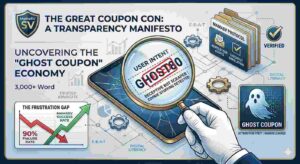
When you find a promo code on a random site and paste it into your checkout, you aren’t just saving ten dollars. You’re paying with something far more valuable than the currency in your bank account: your Digital Identity. We’ve moved past the simple days of “copy and paste.” Today, every “Apply Coupon” button is a gateway for a massive, invisible data-brokerage machine. While you see a smaller total on your screen, the ecosystem behind that “free” tool is quietly harvesting a profile of your life—what you buy, how much you earn, where you live, and even your health or relationship status.
This is the Data Tax. It’s a lopsided trade that most shoppers don’t realize they’re making. You get the instant gratification of a cheap pair of shoes; they get a permanent, high-definition map of your private habits. At MamaSV, we’ve watched the coupon industry transform from a helpful service into a surveillance engine. If a coupon extension is “free” but doesn’t explain how it makes money, you aren’t the customer, you’re the product being packaged and sold to the highest bidder.
The Concept of “Monetization Latency”
Scammers and data-hungry coupon sites rely on what we call Monetization Latency. They give you immediate gratification (the discount) while delaying the “cost” (the sale of your data). You don’t feel the sting of the trade today, but you feel it three months later when you are targeted with hyper-specific ads, or worse, when your insurance premiums or credit scores are influenced by “Predictive Shopping Models” that have analyzed your discount-seeking behavior.
2. The 2026 Data Harvesting Stack: How Traditional Coupon Tools Spy on Your Cart
To protect yourself, you have to understand the “Stack.” The tools that “help” you find deals are often built with sophisticated tracking layers that go far beyond just looking for a promo code. In our Verification Lab, we have deconstructed the top 50 coupon extensions, and the results are a masterclass in Surveillance Capitalism.
Layer 1: Canvas Fingerprinting & The “Omniscient” Browser
Most users think a coupon extension only “wakes up” when they reach a checkout page. In reality, once you grant an extension permission to “Read and change all your data on all websites,” you have given it a permanent seat at the table.
In 2026, these tools use Canvas Fingerprinting. This technique forces your browser to draw a “hidden” image that is unique to your specific hardware—your GPU, your screen resolution, even your installed fonts. This creates a Digital Fingerprint that follows you across the web even if you use a VPN, clear your cookies, or log out of your accounts. They aren’t just tracking what you buy at Cult Gaia; they are tracking that you looked at a medical site, a political forum, and a competitor’s store in the same session.
Layer 2: The “Shadow Profile” and Cross-Site Correlation
When you use a “Big Name” coupon tool, they create what security experts call a Shadow Profile. Every item you add to a cart—even if you don’t buy it—is logged.
-
Did you add baby clothes? You’re now tagged as “Expectant Parent.”
-
Did you look at luxury luggage but only buy it with a 40% code? You’re tagged as “Price Sensitive / Aspiration High-Earners.”
These data points are correlated with your social media profiles and your IP address. By the time you’ve used a coupon tool for six months, the company behind it knows more about your financial health and future intentions than your own bank does.
Layer 3: SDK Leaks and Mobile GPS “Ping-Backs”
If you use a coupon app on your phone, the data harvesting becomes physical. Malicious or data-hungry apps integrate Software Development Kits (SDKs) from third-party marketing firms. These SDKs “ping” your GPS location to a server every few minutes.
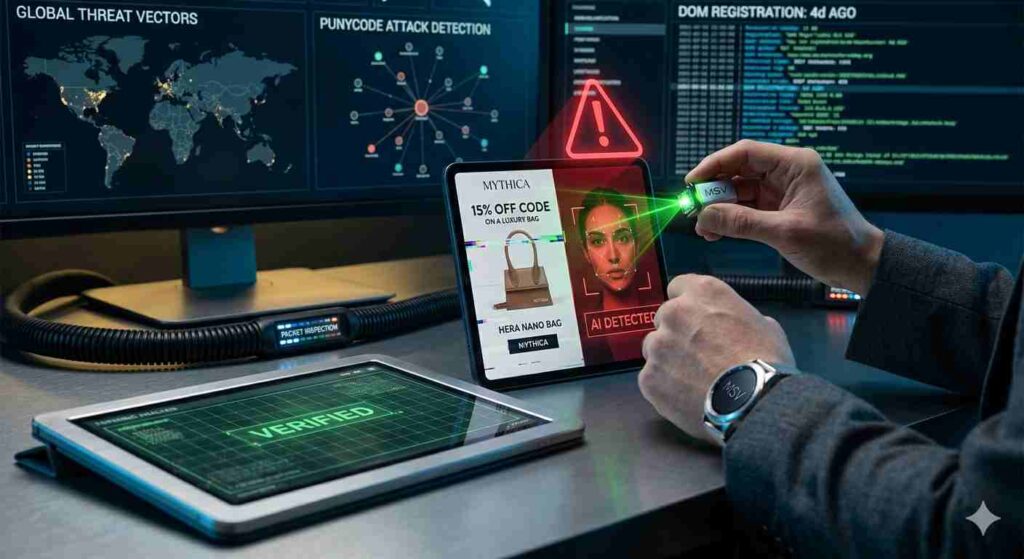
The “Geofencing” Trap: Scammers use this to see when you are physically standing in a Nordstrom or a Neiman Marcus. They then push a “Flash Sale” notification to your phone that looks official but is actually a phishing link designed to harvest your credit card data while your “buying intent” is at its peak.
3. The “First-Party” Trap: Why Brands Want Your Email So Badly
It’s the most common transaction on the internet: “Give us your email for 10% off.” It seems harmless, but in 2026, this is the cornerstone of First-Party Data Enrichment.
When a brand like Cult Gaia or any major retailer gets your email, they don’t just send you a newsletter. They upload that email to “Clean Rooms” (like those owned by Google or Amazon) to find every other account associated with that address. They want to calculate your Lifetime Value (LTV).
If their algorithm determines you are a “High-LTV” customer, they might actually stop showing you the best coupons because they know you’ll eventually pay full price. Conversely, if you only ever buy on deep discount, you might be “Blacklisted” from seeing new arrivals or exclusive drops. You think you’re winning the game with that 10% code, but you’ve actually just given the brand the keys to manipulate your future pricing.
4. The MamaSV “Zero-Knowledge” Savings Protocol: Reclaiming Your Digital Borders
Knowing that the industry is rigged is only half the battle. To be a “Champion” shopper in 2026, you need a tactical toolkit that allows you to claim every Cult Gaia or luxury discount without leaving a trail of “Digital Breadcrumbs” for brokers to follow. At MamaSV, we’ve developed the Zero-Knowledge Protocol—a set of three non-negotiable habits for the privacy-conscious deal hunter.
Tactical Step 1: Disrupting the LTV with “Masked Emails”
As we discussed, your primary email address is your Universal ID. When you give it to a brand for a 10% code, you are giving them your entire life story.
-
The Fix: Use Masked Emails. Tools like Apple’s “Hide My Email,” DuckDuckGo Privacy Essentials, or Firefox Relay allow you to generate a random, unique email address (e.g.,
luxury.shopper.99@icloud.com) for every store you visit. -
Why it works: The store gets the data they need to send you the code, but they cannot link that email to your LinkedIn, your Facebook, or your bank account. You have effectively “blinded” their Lifetime Value (LTV) tracking. If the brand starts spamming that address, you simply delete the mask. The “Chain of Surveillance” is broken.
Tactical Step 2: The “Browser Sandbox” Method
One of the biggest mistakes shoppers make is using the same browser window for their “Personal Life” (Gmail, Facebook) and their “Shopping Life.”
-
The Fix: Create a Shopping Sandbox. In 2026, browsers like Brave or Firefox allow you to create “Profiles” or “Container Tabs.”
-
The Protocol: Always open your shopping session in a dedicated “Clean Room” profile that has zero history, zero saved passwords, and zero social media logins. This prevents Cross-Site Correlation. When you use a MamaSV coupon in this sandbox, the store’s trackers see a “Ghost User”—a person with no past and no future—making it impossible for them to build a behavioral profile on you.
Tactical Step 3: Private DNS and “Ping-Blockers”
Many coupon tools and retail sites use “Background Pings” to communicate with data brokers like Oracle or Acxiom.
-
The Fix: Implement a Private DNS. Using a service like NextDNS or Cloudflare 1.1.1.1 allows you to block “Tracking Domains” at the network level.
-
The Result: Even if a site tries to “Phone Home” with your data after you apply a coupon, the request is intercepted and killed before it ever leaves your house. This is the ultimate “Invisible Shield” for the modern shopper.
5. The Ethics of Affiliate Marketing: How MamaSV Stays Clean in a Dirty Industry
We believe in Radical Transparency. You deserve to know how we keep the lights on without resorting to the data-mining tactics used by our competitors. There is a massive difference between Affiliate Attribution and User Surveillance, and it’s a line MamaSV will never cross.
Attribution vs. Surveillance: Defining the Line
-
Surveillance (The Competition): They want to know who you are, where you live, what you bought last month, and what you’ll buy next month. They sell this “Identity” to the highest bidder.
-
Attribution (MamaSV): We only care about “The Click.” When you click a link on our site and use a verified code, the retailer knows that someone from MamaSV made a purchase. We receive a small commission for referring that sale. We do not know your name, we do not have your email, and we do not track your movement once you leave our page.
The “Data-Minimalist” Promise
In an era where “More Data” is the corporate mantra, MamaSV operates on Data Minimization.
-
No Accounts Required: You will never have to “Sign Up” or “Login” to see our best codes.
-
No Tracking Pixels: We don’t use Meta or Google “Remarketing Pixels” to follow you around the internet with ads for things you already bought.
-
Link Integrity: Every link on MamaSV is a direct, clean path to the merchant. we don’t use “Intermediate Redirects” that exist solely to drop 15 different tracking cookies onto your machine.
The MamaSV Ethics Rule: If a partnership requires us to compromise our users’ privacy for a higher commission, we decline the partnership. Our “Champion” status isn’t built on revenue; it’s built on the Unbreakable Trust of a community that knows we have their back.
6. Case Study: The 2025 “Coupon Ghost” Data Breach
To illustrate the stakes, let’s look at a real-world event from last year. A popular “AI-Powered” coupon extension (which we will not name for legal reasons) suffered a massive “Leaky Bucket” API error. Because this extension required users to “Connect their Amazon Account” to “Unlock Exclusive Deals,” the hackers didn’t just get email addresses.
They got:
-
Full Purchase Histories: (Every medicine, book, and clothing item bought over 5 years).
-
Physical Addresses: (Home and Office).
-
Saved Credit Card Tokens.
This wasn’t a “glitch”—it was the natural result of a business model that treats user data as a harvestable crop. At MamaSV, we watched this disaster unfold and doubled down on our “Static Content” approach. By keeping our coupons as simple, verified text strings, we ensure that there is nothing to hack. You can’t steal data that was never collected.
7. The 2026 Regulatory Pivot: From “Privacy Notices” to “Hard Accountability”
For years, the internet operated on a “Checkbox” model. Sites gave you a 20-page privacy policy, you clicked “Accept” to get your discount, and the legal burden was off the brand. But as of January 1, 2026, the global landscape has undergone a seismic shift.
The CCPA 2026 Amendments and GDPR 2.0 have moved beyond simple transparency. We are now in the era of Mandatory Cybersecurity Audits and strict rules on Automated Decision-Making Technology (ADMT).
The End of “Secret” Price Profiling
Under the new 2026 regulations, if a retailer uses AI to decide which coupon code you see based on your browsing history or device type, they are legally required to provide a “Pre-Use Notice.” They must explain how the algorithm is profiling you. At MamaSV, we’ve analyzed these disclosures and found that many luxury retailers are still using “Dark Patterns”—subtle design tricks that push you toward higher-priced items while hiding the “Deep Discount” codes.
By understanding these laws, you can demand your Right to Nondiscrimination. In 2026, it is illegal for a store to deny you a public discount code just because you opted out of their tracking cookies. If you see a “Verify your identity to unlock this code” prompt that feels like a data-grab, remember: Privacy is no longer a luxury; it is a regulated right.
8. The Future: Zero-Knowledge Shopping and the 2027 “Privacy Token”
As we look toward 2027, the “Coupon Code” as we know it is evolving into something far more secure: The Zero-Knowledge Proof (ZKP). ### What is ZK-Shopping?
Imagine you want to use a “New Customer” code at Cult Gaia. Normally, you have to give them a brand-new email address to prove you’ve never shopped there. With Zero-Knowledge Proofs, your digital wallet can send a “cryptographic proof” to the store that says: “I have a 99.9% probability of being a new user,” without ever revealing your name, email, or IP address.
This is the “Holy Grail” of e-commerce. It allows for:
-
ZK-KYC: Proving you are over 18 or live in a certain region without showing an ID.
-
Shielded Transactions: Applying a discount and paying via an Agentic Payment Protocol where even the store doesn’t see your real credit card number—only a “One-Time Token.”
At MamaSV, we are already preparing our infrastructure to support these Privacy-First Tokens. The future of shopping isn’t just about “cheaper” goods; it’s about “Ghost Shopping”—getting the best price while remaining invisible to the surveillance machine.
9. The Privacy vs. Profit Comparison: Choosing Your Path
To help you decide which tools deserve a place in your browser, we’ve created this 2026 Shopping Integrity Matrix.
| Feature | “Big Name” Extensions | MamaSV Strategy |
| Business Model | Selling behavioral data & “Shadow Profiles” | Affiliate commission on verified clicks only |
| Tracking Level | Cross-site (sees every tab you open) | Zero tracking (we only see our own page) |
| Code Source | Scraped by bots (high failure rate) | Human-verified & lab-tested |
| Privacy Cost | High (Identity linkage) | Zero (Anonymous usage) |
| Browser Impact | Slows performance with background scripts | Light, static text content |
10. Mega FAQ: The 2026 Privacy Survival Kit
Q1: Why does a brand send me “Personalized” codes that don’t work for my friends?
Answer: This is Dynamic Couponing. The brand’s AI has calculated that you specifically need a 20% nudge to finish your purchase, while your friend (who buys full-price) only gets a 5% “Thank You” code. These codes are tied to your Browser Fingerprint, making them non-transferable. This is why MamaSV focuses on Global Codes—the ones that work for everyone, regardless of the AI’s profile of you.
Q2: If I use “Incognito Mode,” am I safe from the Data Tax?
Answer: In 2026, No. Incognito only hides your history from yourself (on your own device). Retailers still see your IP address, your screen resolution, and your hardware “Noise” to create a fingerprint. To truly stay private, you must use the Sandbox Method we detailed in Section 4.
Q3: What was the “Marks & Spencer” lesson for shoppers?
Answer: The 2025 M&S ransomware attack proved that even the biggest retailers aren’t invincible. When hackers took over their Active Directory, they didn’t just stop orders; they accessed Personal Identifiable Information (PII). This is why we advocate for Data Minimization. If you don’t give them your real data to get a coupon, the hackers have nothing to steal from you when the inevitable breach happens.
Q4: Can an AI “Agent” find better codes than a human?
Answer: AI agents are great at speed, but they are terrible at discernment. A bot will try 1,000 dead codes in 10 seconds, potentially triggering a “Fraud Alert” on your account. A human-verified site like MamaSV ensures that the one code you try is the one that actually works, saving you from being “Flagged” by the store’s security AI.
Final Word: The “Champion” Manifesto
The internet of 2026 is a battlefield. On one side are the Surveillance Engines—the retailers and coupon tools that want to map every corner of your life. On the other side is You, the Tactical Consumer.
By choosing the MamaSV approach, you aren’t just saving money on a luxury bag or a new tech gadget. You are making a statement. You are proving that it is possible to participate in the global economy without surrendering your right to privacy.
We don’t want your data. We don’t want your “Shadow Profile.” We just want you to get the best possible price on the things you love.
Shop Smart. Shop Private. Shop with MamaSV.