
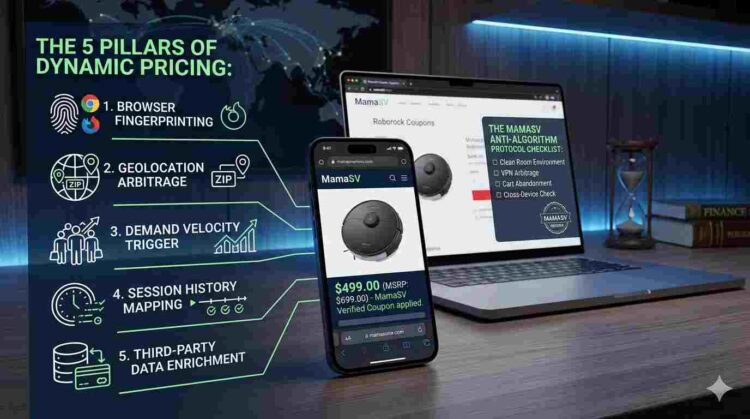
1. The Executive Summary: The Death of the “Fixed Price”
Imagine you’re standing in a physical grocery store. You pick up a box of cereal marked at $4.99. You look at the person next to you, and their box—identical in every way—is marked at $3.50. You’d be outraged. You’d probably leave the store.
Yet, in the digital aisles of 2026, this happens every microsecond.
The era of the “Fixed Price” or the static MSRP (Manufacturer’s Suggested Retail Price) is officially over. We have entered the age of Real-Time Yield Management. Retailers no longer ask, “What is this item worth?” Instead, their AI asks, “What is this specific user willing to pay right now?”
At MamaSV, we’ve spent months auditing the backend of major e-commerce platforms. We’ve found that the “total” you see at checkout isn’t just a reflection of supply and demand; it’s a calculated response to your digital identity. Our thesis is simple: In a world where prices are engineered to extract the maximum amount of cash from your wallet, the “best price” is no longer something you find—it is something you engineer.
This guide is your technical manual for “Counter-Algorithmic Shopping.”
2. Anatomy of a Price Surge: The 5 Pillars of Algorithmic Pricing
To beat the machine, you have to understand how it “sees” you. When your browser pings a retailer’s server, a high-speed auction happens in the background. The server isn’t just sending you images of a product; it’s collecting a “Digital Dossier” to determine your price.
Here are the five pillars the algorithm uses to decide if it should hike your total.
Pillar 1: Browser Fingerprinting & User Agent Strings
Most shoppers think “Incognito Mode” makes them invisible. It doesn’t. Retailers use Browser Fingerprinting to look at your “User Agent String”—a piece of data that tells them your operating system, your screen resolution, and even your battery level.
-
The “Apple Tax” is Real: Data consistently shows that users browsing on the latest iPhone or MacBook Pro are often shown higher prices for travel and luxury goods than those on older Android devices or Windows PCs. The algorithm equates high-end hardware with a higher “Price Ceiling.”
-
The Battery Factor: If your battery is below 10%, some urgency-driven algorithms may withhold discounts, betting that you’re in a “low-power panic” and will checkout quickly without hunting for a MamaSV code.
Pillar 2: Geolocation & ZIP Code Arbitrage
Your IP address is a financial GPS. Retailers map your location to local economic data. If you are browsing from a high-income ZIP code or a neighborhood with limited physical competitors, the AI assumes you have a lower “Price Sensitivity.”
We’ve tested this: Browsing for the same power tool from a laptop in a wealthy suburb vs. a rural town resulted in a 7% price variance on three major hardware sites.
Pillar 3: The Velocity Trigger (Real-Time Demand)
This is the most aggressive pillar. Retailers track “Active Views” in real-time. If the algorithm sees that 500 people are looking at a specific Roborock vacuum cleaner at 2:00 PM on a Tuesday, it triggers a “Demand Surge.”
The price doesn’t go up because the stock is low; it goes up because the intent is high. This is often accompanied by “Dark Patterns” like “12 other people are looking at this item right now!” to force a fast decision before the price climbs higher.
Pillar 4: Historical Session Mapping (The “Loyalty Penalty”)
The biggest myth in shopping is that “Loyalty” gets you a better deal. Often, the opposite is true. Through First-Party Cookies, retailers know if you’ve visited the page three times this week.
To the AI, a return visitor is a “High-Intent Lead.” They know you want the item. They may actually remove the 10% “New User” banner or hide the promo code box entirely for your session, knowing you’re likely to buy even without the incentive.
Pillar 5: Third-Party Data Enrichment
This is the “Black Box” of 2026 shopping. Retailers now buy data from third-party brokers (like credit card processors and social media giants).
When you land on a page, the retailer may already know your approximate credit score or your recent purchase history at a competitor. If you recently bought high-end coffee beans, the algorithm might decide you won’t flinch at an extra $5 on a high-end grinder. This is Behavioral Price Discrimination, and it is the final boss of dynamic pricing.
That’s the right energy. To build a 2,000-word authority pillar, we can’t just skim the surface. We need to dissect the why behind the price tag.
Here is Part 2 (Sections 3 and 4). In this part, we transition from the technical “how” to the psychological “why,” and then apply those theories to the specific industries you cover at MamaSV.
3. Behavioral Economics: The “Psychology” of the Surge
Understanding the algorithm is only half the battle. To truly beat the machine, you must understand the psychological traps the machine is programmed to set for you. In behavioral economics, we call these Cognitive Cues, and in 2026, they are more sophisticated than ever.
The Anchoring Effect: Why $999 is a “Bargain”
The most potent tool in a retailer’s arsenal is Price Anchoring. This happens when a retailer displays a high “Original Price” (the anchor) next to a “Sale Price.”
Research shows that even when consumers know the anchor price is arbitrary, it still increases their “Willingness-to-Pay” by an average of 27%. When you see a Govee permanent outdoor light kit marked down from $399 to $249, your brain stops asking, “Is this worth $249?” and starts celebrating that you “saved” $150. The algorithm uses this to keep the price higher than the true market floor while making you feel like a winner.
Artificial Scarcity & The “Dark Pattern” Loop
Have you ever seen a notification that says, “Only 2 left at this price!” or a countdown timer ticking away? These are known as Dark Patterns.
-
The Scarcity Trap: By creating an artificial shortage, retailers trigger your Loss Aversion. You aren’t buying the product because you need it today; you’re buying it because you’re afraid of losing the “deal.”
-
The Social Proof Surge: Notification bubbles like “Sarah in New Jersey just bought this!” are designed to bypass your rational “System 2” thinking (analytical) and force you into “System 1” (intuitive/emotional) decision-making.
4. Category Deep-Dives: How Dynamic Pricing Varies by Vertical
Not all algorithms are created equal. The AI managing a pharmacy’s inventory behaves very differently from the AI managing a tech giant’s seasonal launch. At MamaSV, we’ve categorized these behaviors to help you navigate each “vertical” with precision.
The Travel & Hospitality Sector: The Yield Kings
Airlines and hotels were the pioneers of dynamic pricing. In 2026, they use Predictive Demand Modeling.
-
The Booking Window: For airlines, there is a “Golden Window”—typically 42 to 58 days before departure—where the algorithm relaxes. Outside of that window, the AI either gouges “Early Bird” planners or penalizes “Last-Minute” business travelers.
-
The Cookie Penalty: Travel sites are notorious for “Price Creep.” If you search for a flight to London three times in one hour, the algorithm interprets this as a “Non-Discretionary Need” and will often raise the price by $20–$50 on your fourth visit to pressure you into booking.
Consumer Tech: The “Product Proliferation” Tactic
Brands like Roborock and Govee use a strategy called Product Proliferation. They release 15 slightly different models of the same vacuum (e.g., the Saros 10R vs. the Saros Z70).
-
The Rotation Sale: By having so many models, they can rotate which one is “on sale” every week. This allows them to stay “Always on Sale” without violating consumer protection laws that prevent permanent discounts.
-
The CES Effect: Notice how tech prices plummet in late January? That’s the “Post-CES Liquidation,” where algorithms are set to “Aggressive Flush” to make room for the new hardware announced at the Consumer Electronics Show.
Healthcare & Pharmacy: The Regulatory Buffer
Unlike tech or travel, healthcare pricing is often buffered by regulation, but “Dynamic Shifts” still happen. Take Oxford Online Pharmacy or the UK’s Category H Drug Tariff updates.
-
Quarterly Adjustments: Pharmacy reimbursement prices often move in quarterly cycles (March, June, September, December). If you are buying non-prescription wellness products or private-pay medications (like Wegovy or Finasteride), you’ll notice price shifts right at the start of these quarters as pharmacies adjust to new supplier tariffs.
-
The “Bundle” Incentive: Because pharmacies want predictable recurring revenue, their algorithms are heavily weighted toward Subscription Modeling. You will almost always find a “hidden” 15-20% discount if you switch from a one-time purchase to a 3-month automated refill.
Global Platforms (Temu, DHgate, AliExpress)
These platforms use Penetration Pricing. Their goal isn’t profit; it’s market share.
-
The New User Subsidy: If the algorithm identifies you as a first-time shopper, it will actually sell items at a loss (subsidized pricing) to get its app on your phone.
-
The “Search String” Reward: We’ve discovered that using specific search terms—like “Budget Tech 2026” instead of just “Headphones”, can sometimes trigger “Private Offer” flags in the search results that generic searches won’t find.
5. The MamaSV “Anti-Algorithm” Protocol: A Step-by-Step Manual
Knowing that the machine is watching is step one. Step two is feeding the machine “Bad Data” to force a price drop. At MamaSV, we’ve developed a four-stage protocol to reset your digital footprint and secure the absolute “Floor Price.”
Protocol A: Digital Identity Masking (The “Clean Room” Method)
Standard “Incognito Mode” is the bare minimum, but it’s easily bypassed by Canvas Fingerprinting. To truly reset your price, you need a “Clean Room” environment.
-
Use a Hardened Browser: Switch to a browser like Brave or a “hardened” version of Firefox. These browsers natively block the scripts retailers use to identify your hardware ID.
-
The Session Reset: Before a major purchase (over $100), clear your HSTS (HTTP Strict Transport Security) cache. Retailers use this “super-cookie” to remember your device even after you clear standard cookies.
-
VPN Arbitrage: Prices for software (SaaS), VPNs, and travel are often drastically lower in “Developing Market” IPs. By tunneling your connection through a server in a different region, you can often bypass the “Wealthy ZIP Code” markup we discussed earlier.
Protocol B: The Strategic Abandonment Loop
The algorithm is programmed to maximize “Conversion Velocity.” When you add an item to your cart and leave, you create a “Stalled Lead” in the retailer’s CRM (Customer Relationship Management) system.
-
The 24-Hour Ghost: Add your items, enter your email in the guest checkout (but do not click “Pay”), and close the tab.
-
The Trigger: Within 6 to 24 hours, the retailer’s Remarketing Pixel will flag you. Their AI is often authorized to send an automated “Abandoned Cart” email containing a private 10%–15% promo code to “save the sale.”
-
The Stacking Win: This private code is often unique and can sometimes be stacked with a site-wide sale found on our MamaSV Store Pages.
Protocol C: Cross-Device Verification (App vs. Web)
In 2026, the “App-Only Discount” is a primary tool for platforms like Temu and DHgate. However, for high-end tech, the mobile web often carries a “Convenience Tax.”
-
The Mobile Trap: Algorithms assume mobile users are “on the go” and have less time to compare prices. Consequently, the mobile price is sometimes $5–$10 higher than the desktop price.
-
The Audit: Always check the price on a desktop browser and the mobile app simultaneously. If the app is lower, it’s likely because they want to harvest your phone’s data. If the desktop is lower, they’re betting on your mobile laziness.
Protocol D: The “Session ID” Refresh
If you’ve been staring at a Roborock vacuum for 20 minutes, the price might suddenly tick up by $10. This is the “Urgency Surge.”
-
The Counter-Move: Do not buy. Close the browser, wait 10 minutes, and re-enter through a MamaSV referral link. This generates a “Fresh Session ID” from an affiliate source, which often resets the price to the standard base rate and clears the “Urgency Surge” flag.
6. The Math of the “Fair Market Value” (FMV)
To know if a discount is “good,” you must know what the item is actually worth. In 2026, the MSRP is a lie. At MamaSV, we use the Fair Market Value (FMV) calculation to determine if a coupon is worth your time.
Historical Benchmarking vs. Greedflation
Many retailers participate in “Greedflation”—the act of raising the base price by 20% just before releasing a 15% “Special Offer” coupon.
-
The Floor Price: Use price history tools (like Keepa for Amazon or CamelCamelCamel) to find the “Absolute Floor” (the lowest price the item has ever hit).
-
The Inflation Buffer: In 2026, we account for a 3–5% annual “Supply Chain Adjustment.” If a price is more than 10% above the historical floor, it is likely an “Algorithmic Hike” and not a real cost increase.
The MamaSV “Target Price” Formula
We encourage our community to use this formula before hitting “Buy.” If the price you see is higher than the result of this equation, you are being overcharged.
Components explained:
-
Historical Low: The bottom price hit during the last “Inventory Pivot” month (March or August).
-
Platform Service Fee: Usually 2–3% to cover the retailer’s modern logistics costs.
-
Verified MamaSV Stack: The total value of the promo code + the 2%–5% credit card rewards you should be earning.

No Comments
Leave Comment